
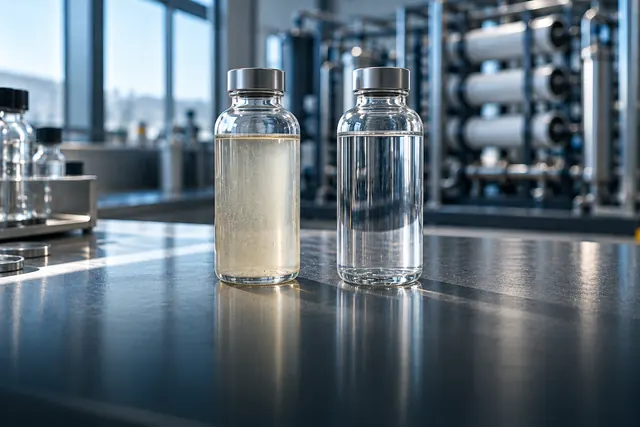
By delaying crystal growth, an antiscalant prevents salts that exceed saturation on the concentrate side from precipitating on the membrane surface. The typical dose is 2–5 mg/L and is calculated with software based on the water analysis. Compared with softening, it offers a low operating cost, but on its own it may not be enough with silica and high hardness.
Technical glossary· Membrane technologies
Antiscalant
Short definitionA chemical dosed into the feed water to prevent calcium carbonate, sulphate and silica from precipitating on RO membranes.
Articles that mention this term
Read about the topic in depth
Free water analysis
Let's choose the right system for your facility together
We collect your sample, analyse it in our own laboratory and present a system proposal tailored to you in a report based on the results.
- Our own laboratory
- On-site survey
- Written report