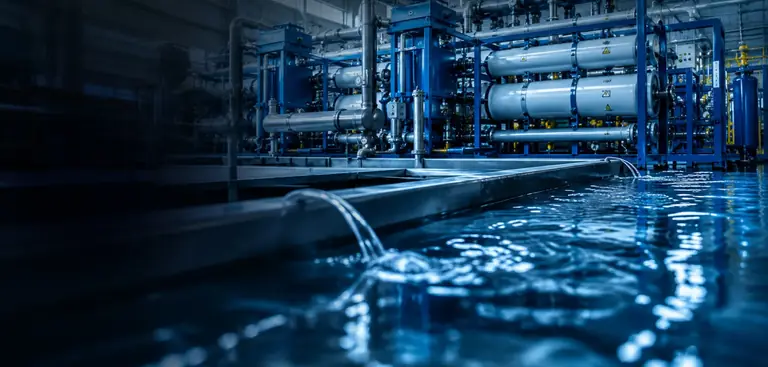
Osmosis is the natural passage of water from a dilute solution to a concentrated one. In reverse osmosis, a pressure higher than the osmotic pressure is applied to the concentrated side to reverse the flow: water passes through the membrane while the salts stay on the concentrate side. TFC (thin-film composite) spiral-wound membranes have pores in the order of 0.0001 micron; they retain ions, bacteria and viruses.
Key concepts
- Recovery: the ratio of product water to feed water (typically 50–75%).
- Salt rejection: the percentage of salt removed (96–99%).
- Concentrate: the waste stream in which the salts are concentrated.